Happy New Year. I have say that it does feel that 2026 started a very long time ago even if my calendar says that it is still January. Things are tough. The Home Office machine has crept slowly back into gear. They are making decisions, but unlike the last backlog clearing exercise, those decisions are negative and of poor quality. It is overloading the tribunals and there simply isn’t capacity in the legal aid sector to ensure that people have representation. The net result is an awful lot of homelessness. Even when people win, the Home Office want you out of your accommodation in 28 days (if you follow the link, you will see that they do not always get their way. It doesn’t help much). It pushes the burden onto the council. The council will do their best to avoid it, the voluntary sector and the community picks up the pieces.
Everything is creaking. Your support, the community you have built, the love you have shown, it’s a lifeline. Every week at the Jollof Café, there is a new person who needs assistance. You have kept them off the streets, at least for now. The amazing volunteers have found legal support and signposted people onto other agencies who can do more. It’s just amazing. The problem is of course we need more money and more long-term accommodation. Do keep telling your friends.
Moving Lives
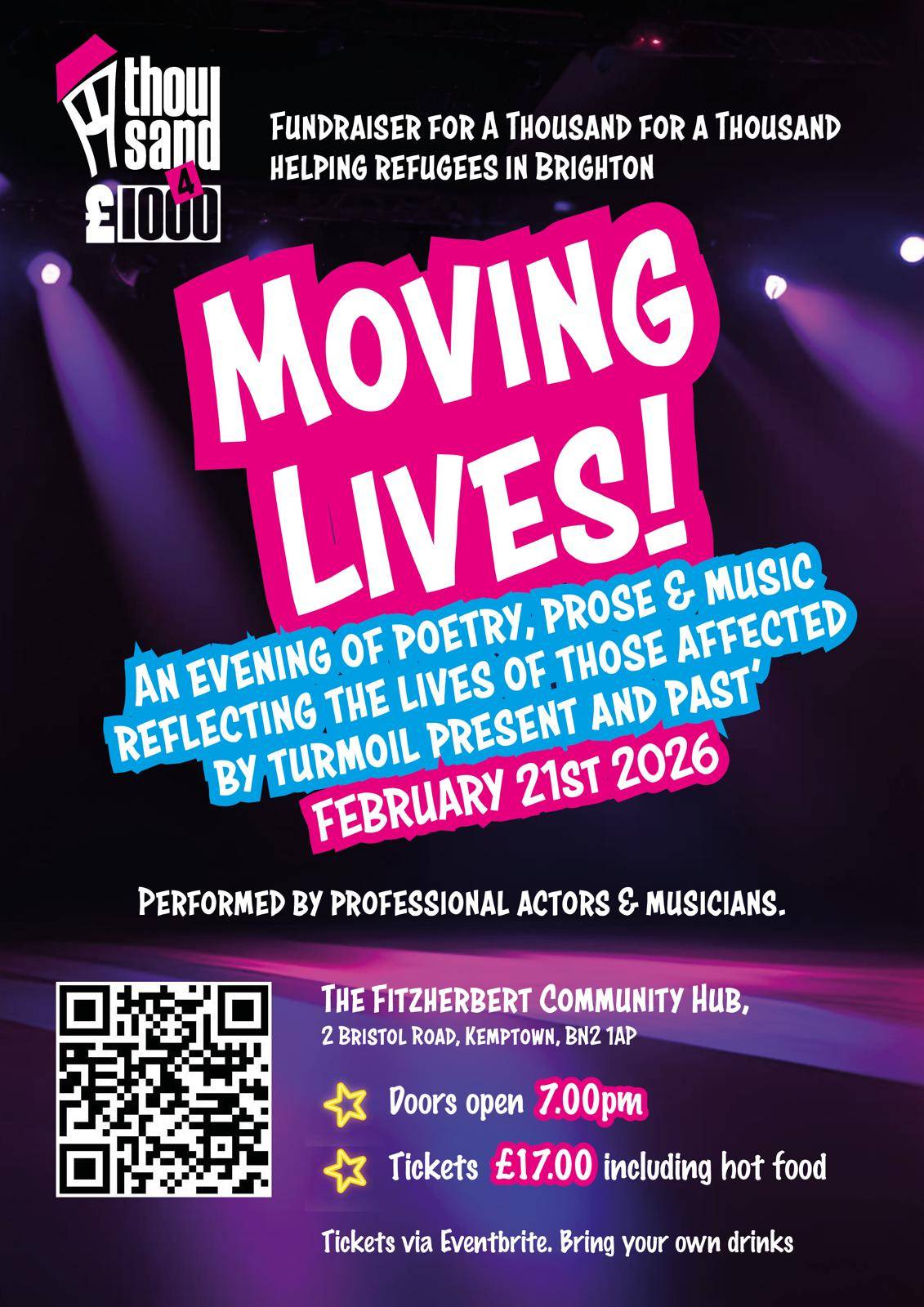
One thing that you can tell your friends about are two upcoming events. The first is our very own Moving Lives on Saturday, 21st December (my little sister told me that I should write dates as ordinals, what do people think?). It is an evening of poetry and prose, ranging from the frivolous to the serious, performed by a troop of professional performers. It also involves music and delicious food. It is at the Fitzherbert Community Hub in Kemptown, which I think is a new departure for us. It is good to be bringing joy to new places. That is what migration is all about, right? Anyway, doors at 19:00 and tickets at £17. See you there.
Refugee Valentine
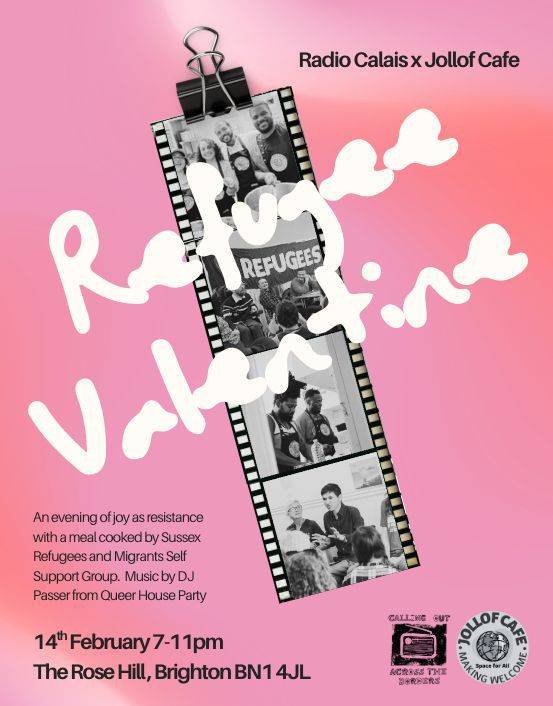
The Jollof Café, on the other hand, are getting back to their roots. They will be doing their annual Refugee Valentine with food and music at the Rose Hill on 14 February. It is a celebration of love that crosses borders. Even if you have a date for Valentines, you are more than entitled to come to the event. You can do your dull, romantic dinner for two another day. Say it with your community. You can get your tickets in advance, £8 unwaged, £12 waged from the Rose Hill.
Subject, Object, (love is a) Verb
All love crosses borders. Love is not love that alters when it alteration finds. Sure, I agree, but love will always alter you. It’s certainly not love if it’s locked up behind its own boundary, closed to the possibility of the new. Love is transformative. It opens our eyes and our hearts. It requires being open, being vulnerable, being naked. When that happens, not only are you transformed from stranger to friend, but you are transformed from object to subject. Love may not be that which gives flesh to our bones, but it is perhaps that which makes the word flesh. It is the action that turns the abstract idea into material reality. It makes the possible, actual. I do think that we are running out of time. What we are seeing in the States is coming here. For the moment, the government is trying to achieve the same result within the law. But this involves breaking more fundamental principles of legality. It involves removing legal protection from the stranger. It is to turn her from subject into object.
Less abstractly, they are proposing to remove your right to have your asylum claim heard before a judge, if the Home Office refuse it. The justification is that this is necessary to clear the backlog. They say that the new decision-makers will be independent of the Home Office. These two claims are incompatible. The system we have now is one in which the decision-maker is independent of the Home Office. There is a backlog. What they want is bad decision-making, or, in other words, high levels of refusal.
Even if they do that, they are not getting people out of the country without massively increasing enforcement and detention. Immigration enforcement and incarceration are not pacific, bureaucratic processes. They involve a great deal of physical violence. Even if they put the money up for that – and prohibition is always more expensive than permission – they are also going to have to restrict rights to judicial review before removal, because of course the asylum decisions were unlawfully taken in the first place. The inevitable endpoint is brute force. It is paramilitaries terrorising communities. It does not have to happen. Brute force is the inevitable result of a system that dehumanises people. It is, however, impossible to dehumanise a person. Bureaucracies may try, but they cannot succeed as long as they respect the law. This is because laws are norms, not expressions of inevitabilities. You can steal, but you shouldn’t. You cannot build a perpetual motion machine, though you should if you could. Law, then, inevitably recognises the personhood of those subjected to it because only a person can recognise the power of a norm.
In response to this problem, the state can withdraw the protection of the law from you. It may allow itself to unleash massive physical force against you, but physical force is only effective because you are fragile. Violence is effective because you are a person. When the state realises that its bureaucracy has failed, it realises that it failed because it could never stop you from being a human. It then chooses to exploit the vulnerabilities of your flesh. There is a better way. It is the way you have already chosen. It is to embrace our fleshiness and our personhood. It is to stop trying to control and order. It is to give up on restriction without justification. It is to recognise that we are always creating and recreating, combining, changing and moving. It is to recognise that we are limitless. It is to love. See you on the 14th and on the 21st.
